Microsoft unveils MAI Code 2, its own coding AI
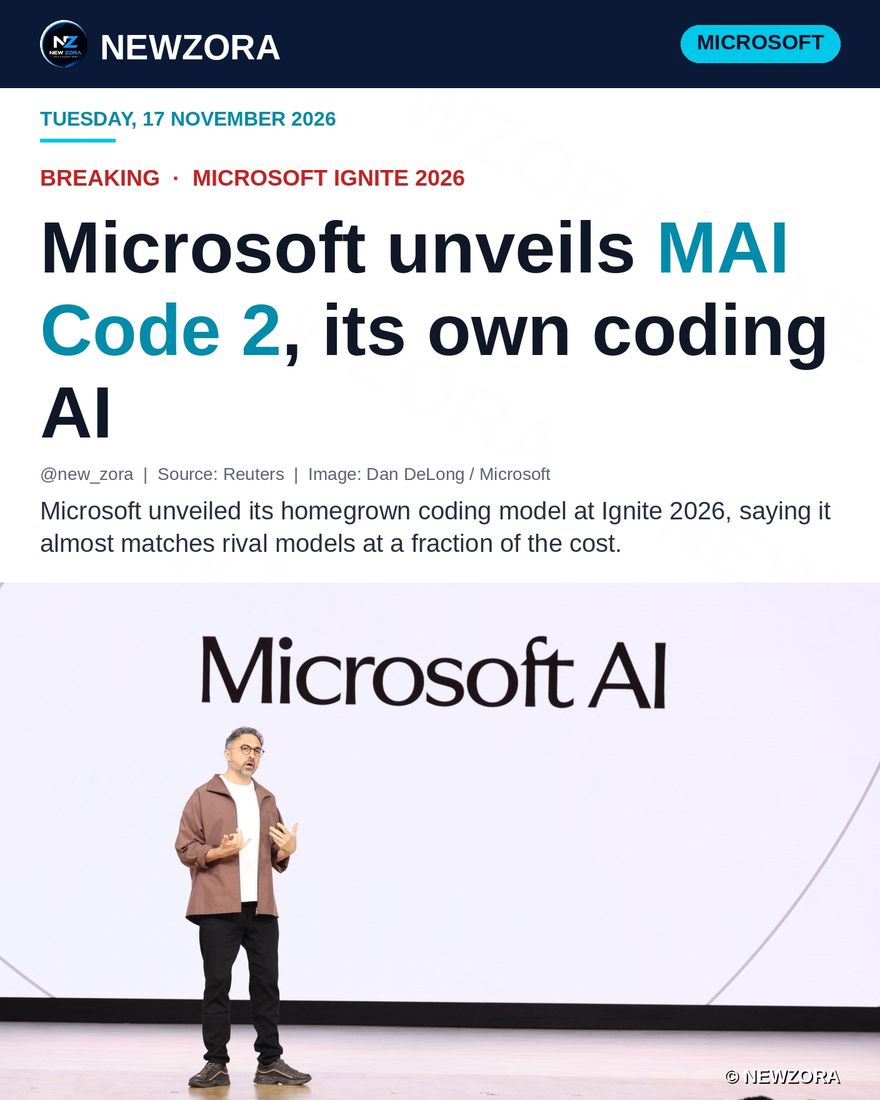
According to Reuters, which reported the announcement on 17 November 2026, Microsoft described MAI Code 2 as a homegrown coding model and stated that it almost matches the performance of rival AI models at a fraction of the cost. That performance characterisation is a company claim, and no independent benchmark results for the model have been published at the time of writing. Microsoft has not disclosed a release date, pricing, or a parameter count for MAI Code 2, and none of those figures is stated in this article.
A domain-specific strategy
The coding model was not unveiled in isolation. Microsoft also announced MAI Cyber 2, a cyber-specific model that is in preview for a limited group of customers, alongside new image-generation and transcription models. Together, the announcements present a suite of new models rather than a single release, and they illustrate a strategy that Microsoft AI chief Mustafa Suleyman has described in public terms: building models tailored to specific domains keeps costs low while matching rival systems and, in some cases, topping model benchmarks.
The logic of the approach is straightforward. A general-purpose frontier model is trained to perform across a wide range of tasks, which requires substantial computational resources at both training and inference time. A model trained primarily for one domain, such as writing and editing software code, can be smaller and cheaper to run while retaining most of the capability that matters for that task. If the cost reduction is large and the capability loss is small, the domain-specific model becomes the more economical choice for organisations that use it heavily. Microsoft's claim is that MAI Code 2 achieves that trade-off. The claim has not been independently verified, and the relevant benchmarks have not been published.
The cost argument
Cost is the central argument Microsoft is making. Training and operating large AI models requires substantial investment in computing infrastructure, and the price of using those models through application programming interfaces is a recurring expense for the organisations that build on them. A model that delivers comparable results at a substantially lower operating cost would change the economics of AI-assisted software development, where coding assistants are invoked many times per day by large engineering teams.
Microsoft has not specified the basis on which it measures the cost advantage, and the company has not published the benchmark results on which its performance claim rests. Readers should therefore treat the performance and cost statements as company assertions rather than independently established findings. The absence of published figures is not unusual at the announcement stage, when a model is introduced before its technical documentation is released, but it means that the central claim of the announcement cannot yet be assessed against evidence.
The cybersecurity model
MAI Cyber 2, the cyber-specific model announced alongside the coding model, is in preview and available to a limited group of customers. Microsoft has positioned the model for security work, and further detail was published on the Microsoft Security Blog. The preview status means that the model is being tested with a restricted set of users before any wider release, and no timetable for general availability has been disclosed.
The pairing of a coding model and a cybersecurity model in a single announcement is notable. Both domains involve work that is structured, repetitive at scale, and sensitive to error, which makes them natural candidates for specialised models. Both also involve organisations that are among the heaviest users of AI-assisted tooling, and therefore the most sensitive to the cost of inference.
Wider announcements at Ignite
The model announcements formed part of a broader set of disclosures at Microsoft Ignite 2026. On the same day, Microsoft and Salesforce announced a partnership under the name Copilotforce, and Microsoft chief executive Satya Nadella announced an AI Transparency Initiative involving more than 40 organisations. The transparency initiative is concerned with disclosure around AI systems, and its announcement alongside the model releases indicates that Microsoft is presenting its in-house model programme within a wider framework of openness about how its systems are built and deployed.
The initiative involves more than 40 organisations, according to the announcement. The composition of the group and the specific commitments it entails have not been described in detail in the sources consulted for this article.
What remains undisclosed
Several questions about MAI Code 2 remain unanswered. Microsoft has not stated when the model will become generally available, what it will cost to use, or how large it is. The company has not published benchmark results that would allow independent comparison with rival coding models. The preview status of MAI Cyber 2 likewise leaves its wider availability undetermined.
These gaps are material to any assessment of the announcement. The significance of a coding model depends on its measured performance, its price, and the terms on which developers can access it. Until those details are published, the announcement establishes intent and direction rather than a verifiable product comparison.
Why the announcement matters
The announcement matters for two reasons. First, it demonstrates that Microsoft intends to compete as a model developer in its own right, rather than relying exclusively on models developed by OpenAI. That has implications for the structure of the AI market, in which a small number of organisations currently supply the most capable models. A further credible supplier of coding models would increase competition and could put downward pressure on the cost of AI-assisted development.
Second, the domain-specific approach, if it delivers the cost savings Microsoft claims, could change how organisations deploy AI. Rather than routing every task through a single large model, an organisation could use a set of smaller models, each suited to a particular task, and pay substantially less in aggregate. That is the argument Microsoft is making, and the evidence for it will come when the company publishes benchmark results and pricing.
Sources
- Reuters, 17 November 2026
- Microsoft Security Blog
- Microsoft News Center