NVIDIA RTX Spark mini PCs are here
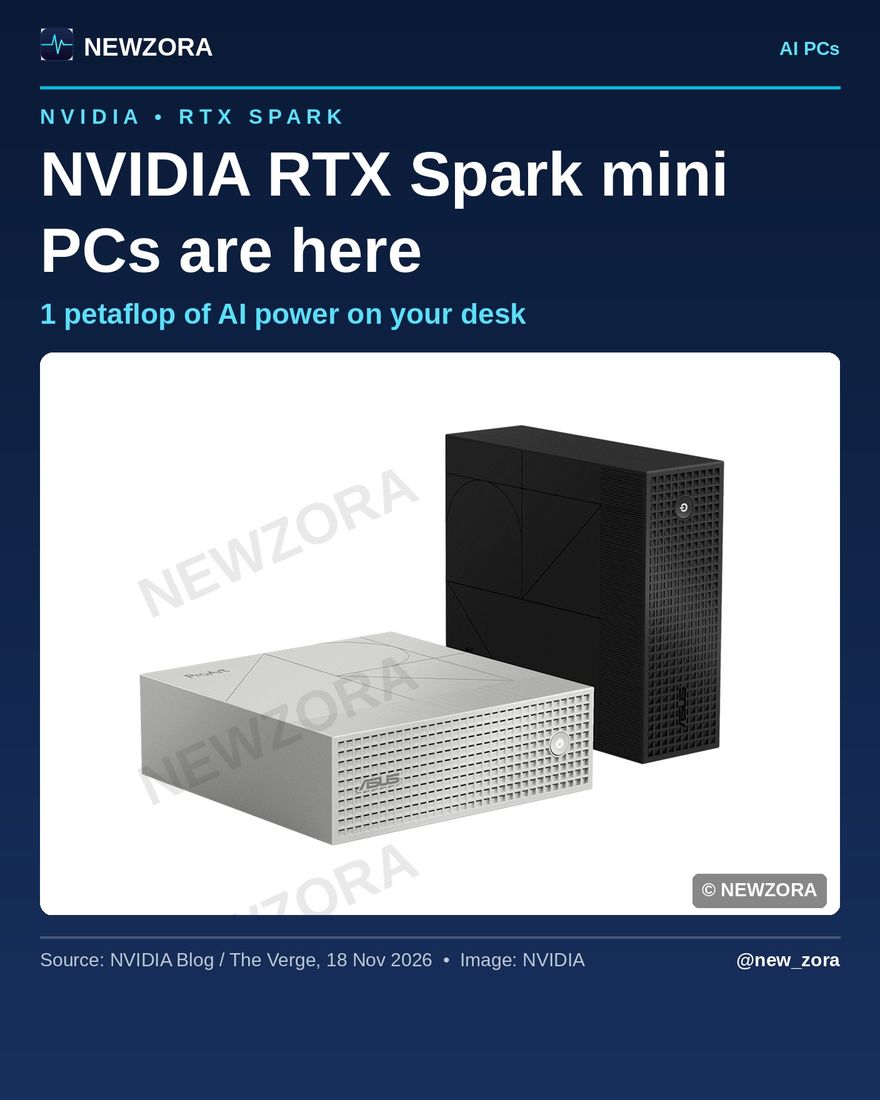
NVIDIA RTX Spark compact desktops went on sale on Wednesday 18 November 2026, bringing the company's GB10 Grace Blackwell Superchip to the desktop in a small form factor aimed at local artificial intelligence development. Asus, Dell and MSI are the first three manufacturers to ship systems, with Acer, GIGABYTE, HP and a Microsoft Surface Dev Box to follow at a later date.
What happened
NVIDIA announced the availability of RTX Spark systems in a blog post titled "NVIDIA RTX Spark Compact Desktops Out Now", published on 18 November 2026. The Verge reported the same day that systems from Asus, Dell and MSI were available to order. The launch converts a product first shown earlier in 2026 into a purchasable desktop, rather than a developer kit or a reference design.
The three launch models differ in configuration and price. Asus offers the ProArt GR1X at 4,499 United States dollars, configured with 64 gigabytes of memory and 1 terabyte of storage. MSI offers the EdgeMesa N AI+, priced from 4,399.99 United States dollars, which makes it the least expensive of the three launch models. Dell offers a Creator Edition Desktop; Dell did not disclose a price for that model at launch.
The hardware
All three systems are built around the same NVIDIA GB10 Grace Blackwell Superchip, marketed as the N1X. The chip combines a Blackwell graphics processor containing 6,144 CUDA cores with a 20-core Grace central processor. The two processors share a unified memory pool of up to 128 gigabytes, so the graphics processor and the central processor draw on the same memory rather than copying data between separate pools.
NVIDIA rates the chip at up to 1 petaflop of FP4 artificial intelligence performance. FP4 refers to four-bit floating-point arithmetic, a reduced-precision format used for inference workloads, where lower numerical precision trades a small amount of accuracy for substantially higher throughput. The figure of 1 petaflop therefore describes performance in a specific low-precision inference mode, not general-purpose computing performance, and it should be read in that context.
According to NVIDIA, a single RTX Spark system can run artificial intelligence models of up to 120 billion parameters locally. That figure is the company's own claim, and it was not independently verified at the time of publication. Dell has cited a higher figure for its own model, but the 120-billion-parameter figure is the one NVIDIA itself states, and it is the figure used throughout this article.
Background
RTX Spark addresses a gap between two existing options for artificial intelligence developers. Cloud-based graphics processors offer large-scale compute but carry recurring rental costs and require data to leave the developer's own machine. Full-size workstation graphics cards offer local compute but demand a large desktop tower, substantial power and, in the current market, a high purchase price. A compact desktop with a unified memory architecture is intended to sit between those two options: local execution, a small footprint and a single purchase price.
The unified memory design is the central technical decision. In a conventional desktop, the graphics card has its own memory, typically 8 to 24 gigabytes, while the system has separate memory for the central processor. Large language models must fit within the graphics card memory to run efficiently, which limits the size of model that a conventional desktop can handle. A 128-gigabyte unified pool removes that boundary, at least in principle, and is the reason NVIDIA positions the system around local model execution rather than gaming or general productivity.
The launch also reflects a broader movement among chipmakers toward desktop artificial intelligence hardware. Several manufacturers have announced compact artificial intelligence workstations in 2026, and the first wave of RTX Spark systems arrives alongside competing products rather than into an empty market. Whether the category becomes a mainstream desktop segment or remains a niche for developers will depend on software support, pricing over time and the performance of the systems in everyday use.
Why it matters
The significance of RTX Spark is practical rather than theoretical. Developers who fine-tune or run large models locally have previously needed either a cloud subscription or a large workstation. A compact system that runs a 120-billion-parameter model on a desk changes the economics of that work: the cost is a single purchase, the data remains on the local machine, and the system can operate without a network connection.
The pricing also sets a clear market position. At 4,399.99 United States dollars for the least expensive launch model and 4,499 United States dollars for the Asus configuration, RTX Spark is priced as professional equipment, not as a consumer desktop. That places it in the same range as a high-end workstation rather than a mainstream personal computer, and it limits the immediate audience to developers, researchers and small studios.
The undisclosed Dell price is a notable gap in the launch information. Dell's Creator Edition Desktop is listed as available, but without a price the three-way comparison is incomplete. Readers considering a purchase should confirm the Dell price directly with Dell before making a decision, rather than assuming it falls between the two published prices.
What is next
Acer, GIGABYTE and HP have been named as manufacturers that will offer RTX Spark systems, and Microsoft has announced a Surface Dev Box built on the same platform. None of those systems was on sale at the time of the 18 November launch, and no availability date or price was disclosed for any of them. Their arrival will widen the range of configurations and may put downward pressure on prices, but that outcome is not yet established.
The more important test will come from independent evaluation. The published figures describe a single chip under specific conditions, and real-world performance will depend on software, cooling in a compact chassis and the workloads developers actually run. Independent benchmarks and long-term reviews, which were not available at launch, will determine whether the 120-billion-parameter claim holds in everyday use.
For now, RTX Spark is available to order from Asus, Dell and MSI. The systems are on sale, the specifications are published, and the first independent tests will show whether the compact desktop delivers on the promise of local artificial intelligence at this scale.
Sources
- NVIDIA Blog, "NVIDIA RTX Spark Compact Desktops Out Now", 18 November 2026
- The Verge, Stevie Bonifield, 18 November 2026